Preparing for a First Meeting About a Local Plan
Prepare for a first meeting about a local plan with clear observations, inclusive questions, and follow-up decisions that keep discussion grounded in local needs.
The most common mistake at a first meeting about a local plan is arriving with a list of projects before the group agrees what it needs to understand. That can leave quieter concerns unheard and send discussion toward solutions before people have compared how they use the place. Preparing for a first meeting about a local plan means bringing useful observations, not a finished answer.
Describe the area through daily routines
Use the names residents use for the area under discussion. A parish boundary may be clear on a map, but daily life can cross it: people may travel to a neighboring settlement for a shop, bus stop, school, playing field, or health service. Note those connections so the boundary does not hide how the place works.
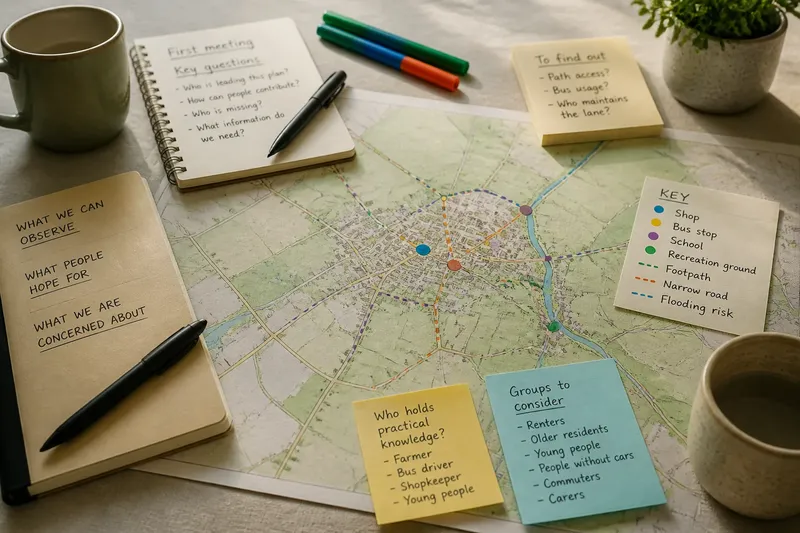
Bring a simple printed street map or annotated parish map if one is available. Mark places that shape daily routines, such as a narrow road used by walkers, a bus stop with nowhere comfortable to wait, a stream that affects access after heavy rain, or a path linking homes to a shared facility. Record what you observe rather than prescribing a fix. “People cross here to reach the shop” invites discussion; a demand for a particular road design closes it down.
Keep the map easy to read, with a few clear marks and a small key. Treat it like a window onto different routines: it should help people see where their accounts overlap or differ, not make one person’s proposal look settled.
Consider who is missing from the room
Before the meeting, list groups whose routines or needs could be affected. Depending on the place, that might include renters and homeowners, young people, older residents, farmers, commuters, people without cars, and people who provide care. The list is a prompt for thought, not a claim that everyone in a group has the same experience.
For each group, ask what could make participation difficult. Meeting times, transportation, childcare, unfamiliar planning terms, or inaccessible information may affect who can take part. Record these as questions for the organizers rather than guessing what people want. For example: “How can young people who use the recreation ground contribute?”
Notice who may hold practical knowledge, too. A farmer may understand seasonal access, a bus driver may know where passengers struggle to board, and a shopkeeper may see how people move through the village at different times. These accounts can help the group identify questions, but one person should not be treated as the voice of everyone in that role.
Keep observations, hopes, and concerns distinct
Divide your notes under three headings: “What we can observe,” “What people hope for,” and “What we are concerned about.” This makes it harder for a proposal or worry to be mistaken for an established fact. “The path is muddy after rain” is an observation; “make it easier to use year-round” is a hope; “a new surface might affect drainage” is a concern to examine.
Say you are preparing for a discussion about a village edge where homes meet working fields. You observe walkers using a field-edge route, record residents’ hope of keeping access clear, and note that farm machinery also needs room to pass during busy periods. At the meeting, you ask when the route is most used and who should be consulted. The resulting discussion can identify the competing needs without pretending they have already been resolved.
Use cautious wording for anything you have not checked. “Residents have raised concern about flooding near the lane” is more precise than “the lane always floods” when you lack direct records or broad agreement. Careful wording helps the group decide what information to seek next.
Bring questions that lead to clear next actions
A first meeting can clarify the process as well as the place. Ask who is leading the plan, which decisions it can influence, how residents can contribute later, and how the group will share notes and follow-up actions. If the work touches formal planning rules, land ownership, or environmental requirements, the answer may depend on local rules and qualified professional advice.
Make questions open enough to invite different accounts, but concrete enough to guide discussion. “What should happen here?” may be too broad. “What do people need this route to do, and when?” gives the group a more useful starting point.
Use these prompts to decide what to check or do next:
- Check whether the map includes places people rely on for everyday needs; if a place is missing, mark it and ask who uses it.
- Check which affected groups are represented in the room; if a group is absent, ask organizers how its members can contribute later.
- Check whether a statement is an observation, hope, or concern; if its status is unclear, rewrite it under the right heading or mark it for verification.
- Check which observations lack a source or direct confirmation; if the information is uncertain, record the gap and ask who can verify it.
- Check whether the plan’s influence and limits have been explained; if they remain unclear, ask who can clarify the process before the group discusses decisions.
- Check whether each follow-up question has an owner; if no one is named, ask the group to assign responsibility or agree how it will do so.
What should the first meeting settle?
Should I arrive with a finished proposal?
No. Bring observations and questions rather than presenting a plan as settled. Early discussion is more useful when people can add context and identify missing voices before the group narrows its choices.
What if people disagree about a place?
Record the different uses and concerns without forcing a quick resolution. The disagreement may point to a need for more listening, clearer information, or a closer look at how the place functions at different times.
How much background should I prepare?
Prepare enough to explain where your observations come from and what remains uncertain. A marked map and a short page of notes are often easier to discuss than a long presentation.
What should I do after the meeting?
Check the shared notes, correct any account that misstates your contribution, and track questions assigned for follow-up. If the notes name no next action, ask who will decide how the discussion continues.
Record what the group still needs to learn
Set aside a section of your notes titled “To find out.” It might include whether a path is publicly accessible, when a facility is busiest, or which organization maintains a stretch of road. Do not turn uncertainty into a confident claim just to make the notes look complete. A clearly recorded gap gives the group a practical question to return to.
For preparing for a first meeting about a local plan, a useful result may be a clearer account of daily connections, a record of whose views are still missing, and follow-up questions assigned to specific people. Before leaving, check that the notes distinguish what the group knows from what it still needs to verify. That small distinction makes the next conversation easier to pick up and harder to mistake for a settled decision.